



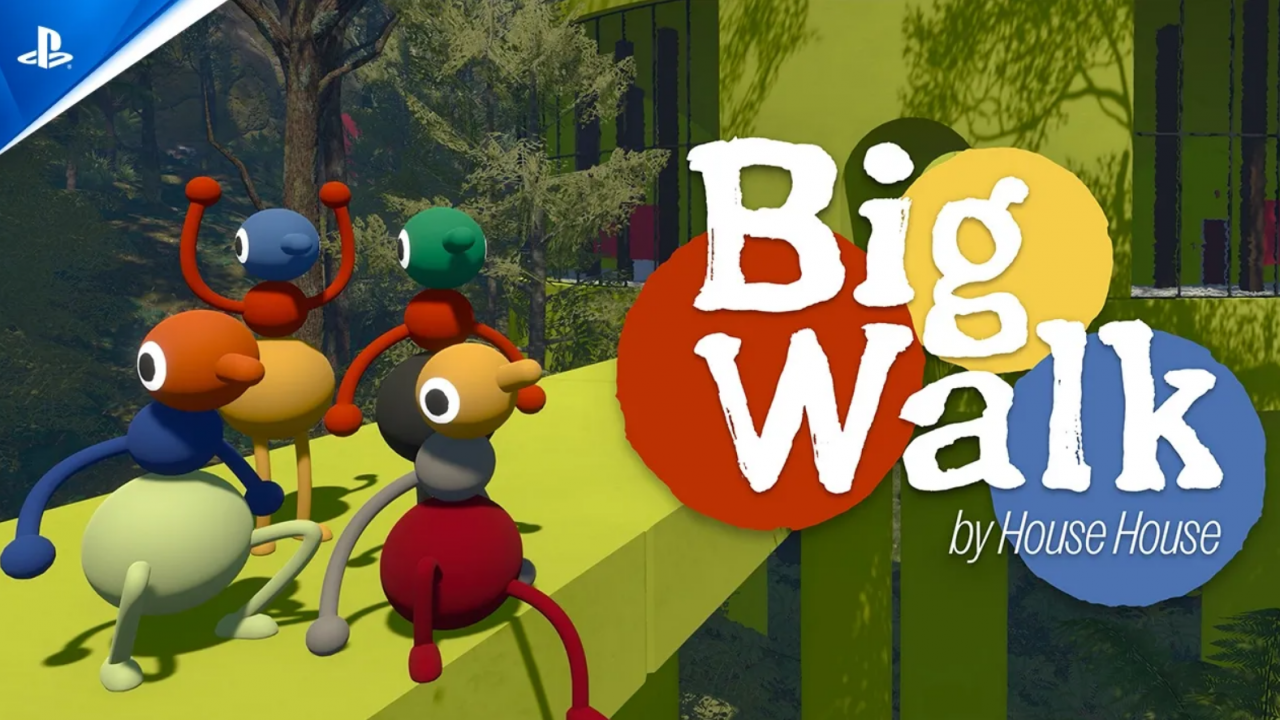
Big Walk is the new co-op adventure from House House, the studio behind Untitled Goose Game. It drops two to twelve friends onto an open island, then makes talking to each other the hardest part. In this Big Walk review, we break down how the proximity chat, puzzles, and island hold up over long sessions. We also cover where it stumbles, what it costs, and which groups will get the most out of it.

Big Walk PC Game Details
Before we begin this review, let’s get some basic things regarding Big Walk out of the way:
| Detail | Info |
| Developer | House House |
| Publisher | Panic |
| Release Date | August 4, 2026 |
| Platforms | PC and Mac (Steam, Mac App Store), PlayStation 5, Nintendo Switch 2 |
| Player Count | 2 to 12 players, online only |
| Single-Player Mode | No |
| Crossplay | Yes |
| Price | $19.99 on Steam |
| Genre | Co-op exploration and puzzle adventure |
Big Walk First Impressions
Big Walk is a co-op exploration game set on a large, uninhabited island. There’s no story crawl, no quest log, and no waypoint telling you where to go. You begin inside a tutorial building that teaches the basics through play. You learn to point, wave, sit, jump, grab items, and pick up your friends.
Then the doors open onto bushland, beaches, rivers, and hills that feel like a real hike, not a game map. Bright, toy-like structures in red, yellow, blue, and green dot that landscape. Most of them hold a puzzle, and every puzzle needs more than one person.


Most puzzles reward your group with small red collectibles, which you’ll almost certainly nickname within ten minutes. Place enough of them and bigger challenges open up, unlocking new ways to move around the island. Big Walk also has a proper ending, plus more to chase after the credits roll.
It shares some DNA with proximity-chat hits like PEAK and R.E.P.O. Big Walk is slower and gentler, though, and it has a real finish line instead of an endless loop.
Big Walk’s Proximity Chat Is the Real Main Character
Most co-op games treat voice chat as a convenience. Big Walk treats it as the core mechanic, and nearly every system bends around that choice.

Voices fade with distance, echo down corridors, and muffle through walls. Step behind a boulder and your friend’s sentence dissolves halfway through. Put a sheet of glass between you, and they might as well be miming.

That’s why the game pushes you so hard to skip Discord and party chat. If everyone can hear everyone at all times, half the puzzles stop making sense. Using an outside call is like doing an escape room with the answer sheet taped to the door.
We strongly recommend following that rule, even when it feels restrictive during the first hour. Play in separate rooms too, because hearing a friend through the wall kills the effect. Text chat works as an alternative and follows the exact same distance rules.

Tools That Keep Big Walk Groups Connected
Once distance cuts your voice off, the island’s tools become your lifeline. Here’s what your group will lean on most.
| Tool | What It Does for Your Group |
| Walkie-talkie | Keeps voice contact across long distances, complete with a satisfying crackle |
| Megaphone | Pushes your voice much farther than normal speech |
| Flare gun | Lights up the sky so lost friends can find the group |
| Binoculars | Scouts distant friends, landmarks, and structures before you commit to a hike |
| Laser pointer | Marks exact objects when “that one over there” stops working |
| Whiteboard | Carries written messages for friends who can’t hear you |
| Flashlight | Becomes essential once night falls and the island goes properly dark |
| Cowbell | Signals your position and annoys everyone within earshot |
| Radio | Plays the soundtrack out loud wherever you carry it |
The catch is that you can only hold one item at first. Backpacks turn up later, but early on every pickup is a trade-off. Do you grab the walkie-talkie to scout ahead, or the flashlight because night is coming?
Our favorite trick was leaving a whiteboard at a trail fork that read “went left, follow the cowbell.” It worked about half the time, which honestly felt like a win.
Getting Lost Is Part of Big Walk’s Design
You will get separated. Someone spots a yellow tower through the trees, drifts toward it, and vanishes within a minute. Night makes it worse, because the island turns genuinely dark and voices disappear just as fast.

Some of our best moments came from those gaps. One of us spent a long stretch alone on a ridge, holding a walkie-talkie that nobody answered. The rest of the group was busy arguing over who got to fire the flare gun.
When that flare finally lit up the sky, the relief felt ridiculous for a game about walking. Big Walk understands that a reunion only matters because being alone felt real.
The Puzzles Make the Whole Group Feel Smart
The puzzles are where Big Walk earns its praise, and they stay fresh across the whole island. Early ones are simple. Stack your bodies into a wobbly tower to reach a high button, with the bottom player steering the entire column.
Later puzzles revolve around information that only one player can access. One person reads a set of symbols while another stands behind soundproof glass, unable to hear a word. Within seconds, your group is inventing sign language out of raised arms, nods, and frantic pointing.

Other challenges muffle your voice and block your vision at once, leaving a teammate to guide you step by step. We’ve never felt so proud of shouting “your other left” across a room.
None of this is hard in the traditional sense, and that’s deliberate. The difficulty lives in the communication, not in obscure logic or trial and error. When a solution clicks, confetti bursts out and everyone starts jumping and waving like they just won a final. It’s a small touch, but it lands every time because nobody solved it alone.
How Big Walk Handles 2, 3, or 4+ Players is a Pleasure to Watch
Before each session, the host picks a 2-player, 3-player, or 4+ player version of the world. Certain challenges change shape to match that choice. Set it to the number of people who will definitely stay, not the number who might show up.
| Group Size | What It Feels Like | Best For |
| 2 players | Focused and efficient, with every puzzle resting on two people | Duos, couples, and puzzle-first players |
| 3 players | Longer information chains and more room for hilarious mix-ups | Small friend groups who want a challenge |
| 4 players | The sweet spot, where puzzles demand real coordination | Most groups |
| 5 to 12 players | Puzzles stay tuned for four, so extra players add chaos rather than difficulty | Big hangout nights |
The Big Walk Island Is Worth Slowing Down For
The island takes inspiration from Wilsons Promontory National Park in Victoria, Australia, shrunk down to a walkable scale. Plants, terrain, and ambient sounds lean realistic, which makes the bright puzzle structures pop even harder.
Nothing rushes you here. There’s no timer, no stamina bar, and no enemies waiting in the grass. Benches, lookouts, and quiet spots exist purely so your group can sit down and watch the sun set.
Music follows the same philosophy. Much of it plays from radios you find and carry, so the soundtrack travels with your group. Carrying a radio costs you a hand slot, though, which turns every playlist into a real sacrifice.
Things We Wish Big Walk Improved Upon
Walking Is Sometimes the Weakest Part of Big Walk
The irony is hard to miss. Moving across open ground feels great, but uneven terrain turns clumsy fast. Characters snag between rocks, fail to climb knee-high ledges, and struggle up steep slopes.
Updates have made it harder to get stuck in some spots, but expect the occasional frustrating scramble. It never ruined a session for us, yet it interrupted plenty of good moments.

The Downtime Won’t Suit Every Group
Big Walk asks for patience. Long hikes separate the puzzle sites, especially before you unlock faster ways around the island. With chatty friends, that downtime is where the best conversations happen. With a quieter group, it can feel like empty mileage.
If your crew needs constant action, faster chaos games will scratch that itch sooner.
Scheduling Is Big Walk’s Real Boss Fight
There’s no matchmaking and no single-player mode. The host keeps the save file, so your group can only continue when the host starts a session. That makes Big Walk feel closer to a weekly board game night than a drop-in game.
Players can join and leave between sessions, but the experience builds on shared knowledge. Groups that stick together get far more out of it.
Audio Needed Early Fixes
At launch, some players found voices far too quiet, even at close range. Later patches normalized voice volume and added separate sliders for different audio categories. If the audio put you off in early August, it deserves another look now.
The Magic Only Works Once
Big Walk’s biggest strength is surprise, and surprise rarely survives a second run. Once you know the solutions, the puzzles lose their spark. The island stays a lovely place to hang out, but the discovery is single-use. So stay away from guides and videos until your group finishes.

Pros and Cons of Big Walk
| What We Loved | What Frustrated Us |
| Proximity chat that turns talking into gameplay | Clumsy movement on rocks and ledges |
| Puzzles that make the whole group feel clever | Long walking stretches between puzzle sites |
| A gorgeous, realistic island with zero pressure | Needs a committed group and a reliable host |
| A real ending, plus post-credits content | Little replay value once solved |
| Crossplay and solid accessibility options | No solo mode or matchmaking |
Verdict: Is Big Walk Worth Playing?
Big Walk is one of the most thoughtful co-op games we’ve played in years. It gets there by taking things away: easy voice chat, quest markers, and solo play. What remains is a game about the people you bring.
The puzzles are clever without being cruel, and the island is gorgeous. The proximity chat creates stories that no script could write.
The rough edges are real, though. Movement stumbles on uneven ground, and the hikes between puzzles will test impatient groups. Getting the same friends online every week can also feel harder than any puzzle on the island.
Our Big Walk review verdict is simple. If you have two to four friends willing to commit, it’s an easy recommendation at $19.99. If your group can’t agree on a schedule, or wants nonstop chaos, look elsewhere.